ContextRAG
A production-grade universal document RAG engine — grounded answers with enforced citations.
Solo full-stack build — Express 5 TypeScript backend, React 19 frontend, MongoDB Atlas data layer.
The Problem
LLMs hallucinate when answering over private documents. Teams need answers traceable to source evidence — not plausible guesses — across messy real-world formats like PDFs, spreadsheets, and slide decks.
The Approach
Two pipelines. An ingestion pipeline turns 15 document formats into parent-child chunk structures with 2048-dim embeddings. A multi-stage query pipeline fuses dense and sparse retrieval, reranks with a cross-encoder, and generates strict-JSON answers whose numbered citations are validated end-to-end by the prompt, the normalizer, and the renderer.
Architecture
- 01
File-first ingestion
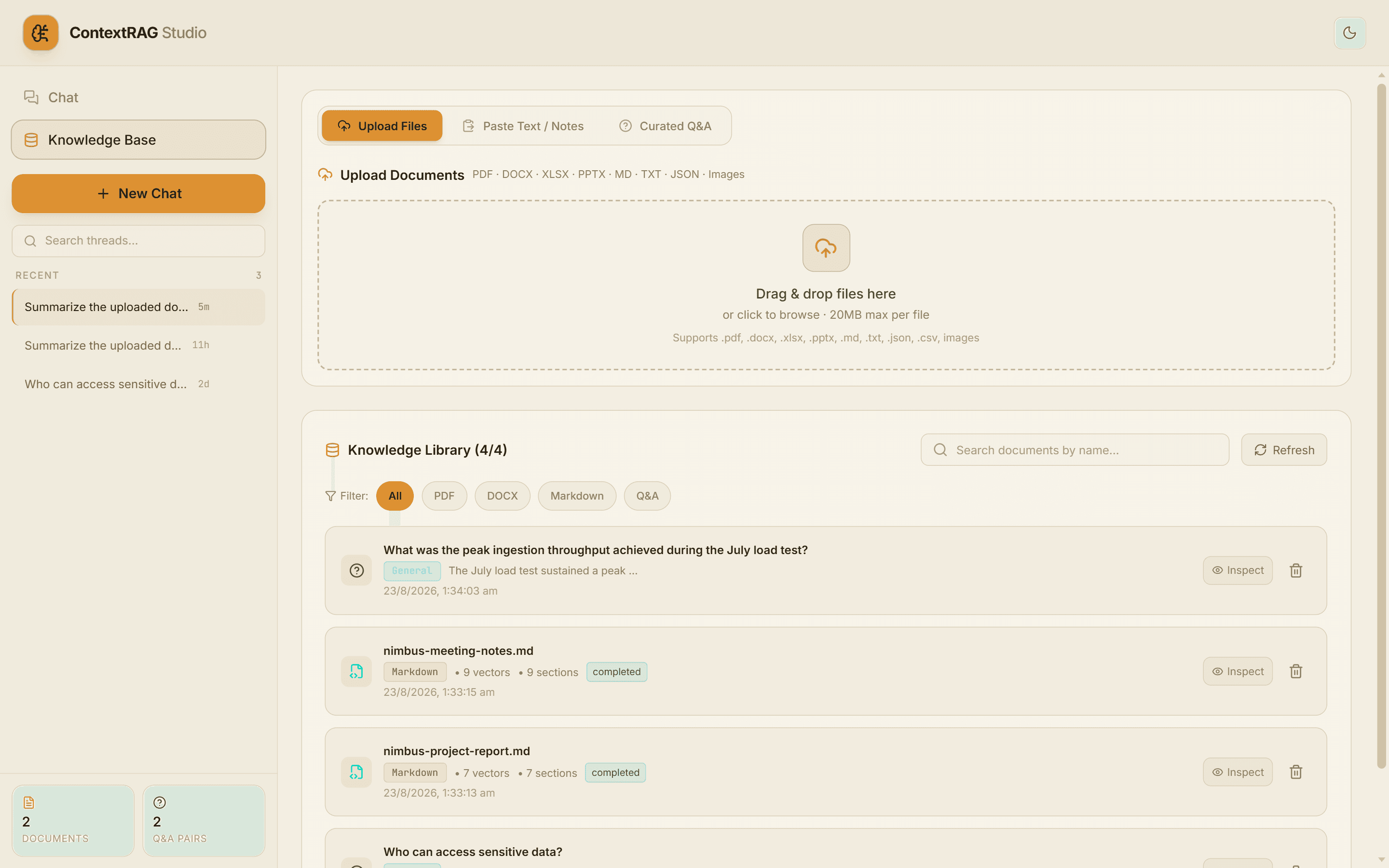
One unified pipeline ingests 15 formats (PDF, DOCX, XLSX, PPTX, MD, TXT, JSON, CSV, images) via Xberg extraction, with a live 4-stage pipeline visualizer in the UI.
- 02
Structural chunking
A custom AST-like chunker respects markdown headers, tables, and code fences — producing parent sections for LLM context and child chunks for precise retrieval.
- 03
2048-dim embeddings
Child chunks are embedded with NVIDIA NIM (nemotron-3-embed-1b) and stored in MongoDB Atlas with auto-provisioned vector and full-text indexes.
- 04
Hybrid retrieval
Dense vector search (Atlas $vectorSearch, cosine) runs in parallel with sparse BM25 keyword search (Atlas Lucene) to catch both semantic and exact-match signals.
- 05
Reciprocal Rank Fusion
RRF merges dense and sparse ranked lists, then hydration attaches parent context and deduplicates — keeping the best child per parent section.
- 06
Cross-encoder reranking
Cohere Rerank v4.0 Pro rescores fused candidates for fine-grained relevance and prunes weak context before generation.
- 07
Enforced citation contract
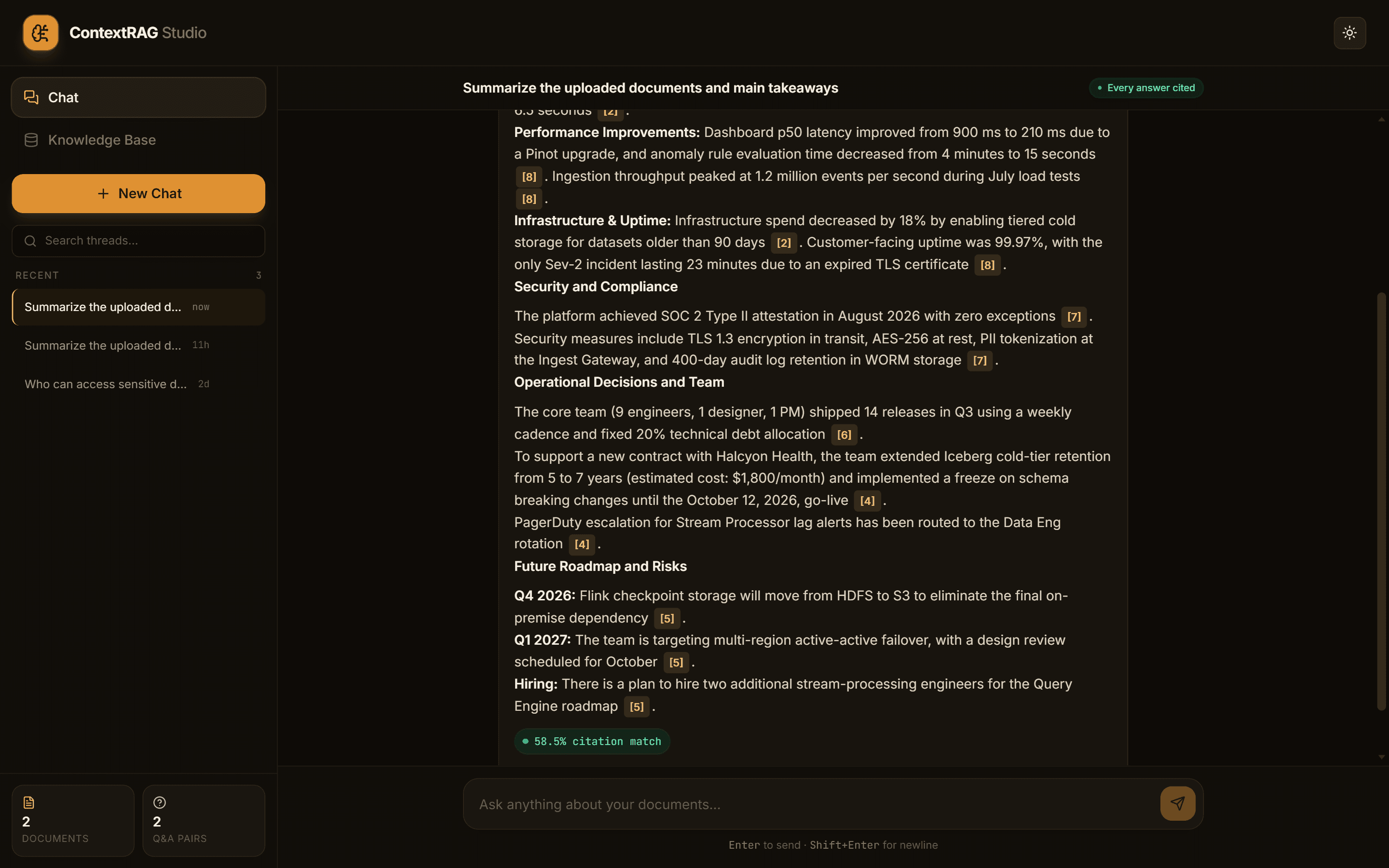
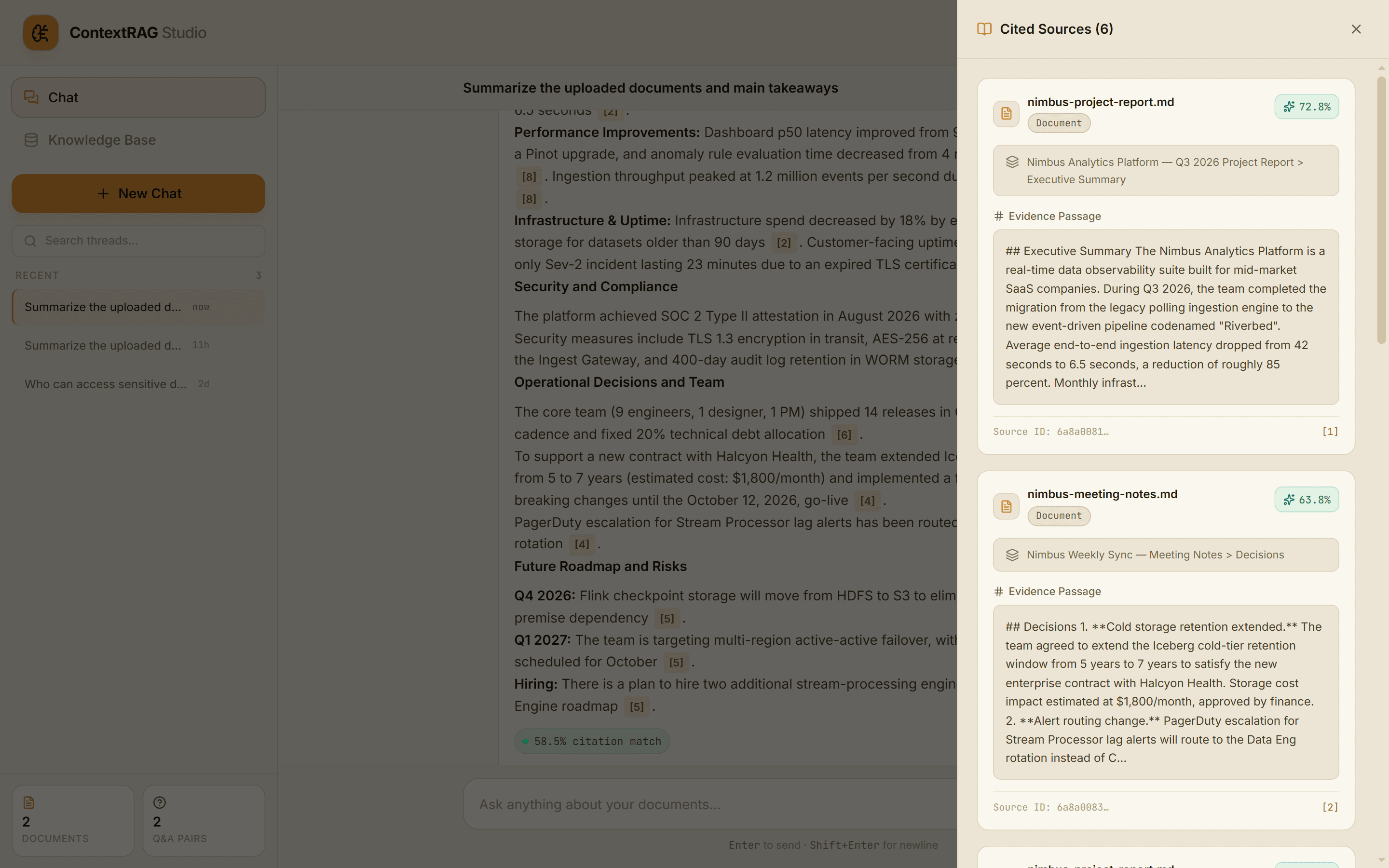
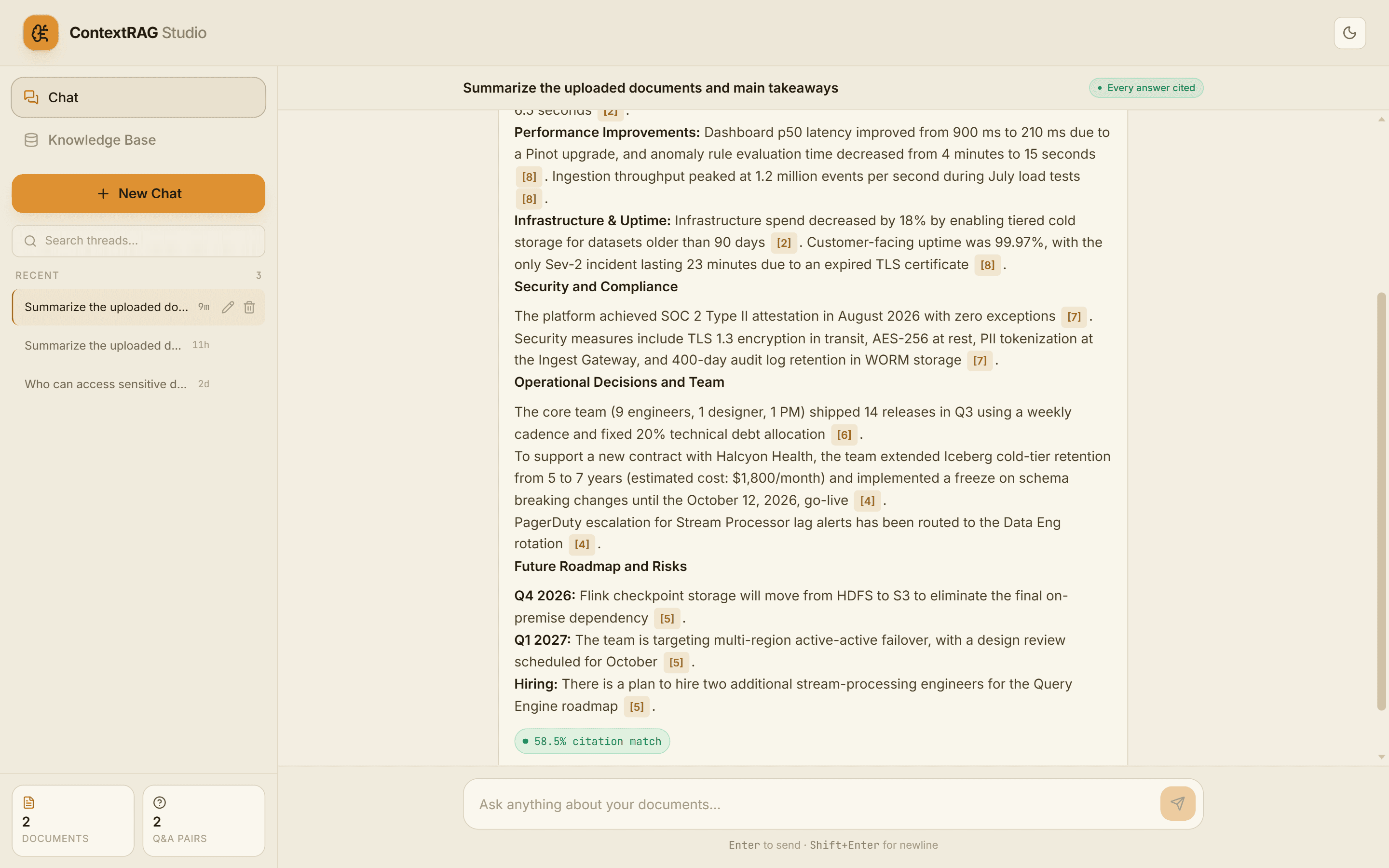
Gemma 4 (31B-IT) emits strict JSON answers with numbered evidence IDs — validated by prompt, normalizer, and renderer, so every claim maps to a retrievable source chunk.
Key Highlights
- Hybrid retrieval — 2048-dim Atlas Vector Search fused with BM25 via Reciprocal Rank Fusion
- Cohere Rerank v4.0 Pro cross-encoder prunes irrelevant context before generation
- Enforced citation contract with per-answer citation-match score and an interactive evidence drawer
Screenshots
What I Learned
- Structured-output contracts turn LLMs from plausible guessers into verifiable systems — validation belongs at every layer, not just the prompt.
- RRF + cross-encoder reranking is a pragmatic default: cheap recall from two channels, then expensive precision applied to a small candidate set.
- Production hardening matters as much as the pipeline — security headers, rate limiting, gzip, centralized retries with backoff, and soft deletes across the knowledge layer.